
Cape Coral, Florida was literally carved out of the wilderness with a shovel and a dream. Today, it stands as one of the most talked-about real estate markets in the entire country — and if you think the story is already remarkable, the next chapter may be even more extraordinary.

A City Born from a Bold Idea
The story of Cape Coral begins not with a municipality or a government plan, but with two brothers and an audacious real estate vision. In 1957, Gulf American Land Corporation founders Leonard and Jack Rosen purchased roughly 103 square miles of largely undeveloped marshland on the southwest coast of Florida for approximately $678,000. They named it Cape Coral — and then got to work building something that had never been done before.
Their plan was breathtaking in scope: excavate hundreds of miles of interconnected canals through the land, using the dredged material to raise the ground above flood level, then sell residential lots to Americans dreaming of affordable waterfront living. Salespeople fanned out across the country, pitching the idea of owning a piece of tropical paradise. The marketing was aggressive, sometimes controversial, and undeniably effective.
Cape Coral was officially incorporated as a city in 1970, at which point it already had a population of around 11,000 residents. What had started as a raw land venture was quickly transforming into a genuine community.
The Canal Network: An Engineering Marvel
What sets Cape Coral apart from virtually every other city in the United States — or the world, for that matter — is the sheer scale of its canal system. Today, Cape Coral boasts more than 400 miles of navigable waterways, surpassing even Amsterdam and Venice. This network of canals, rivers, and tidal waterways remains the city's defining physical characteristic and its most powerful real estate driver.
Not all canals are created equal. Properties situated on direct-access sailboat or powerboat canals — those with no bridges or locks between your backyard dock and the open waters of the Gulf of Mexico — command a significant premium and represent some of the most coveted real estate in all of Southwest Florida. This distinction between freshwater canals, brackish canals, and Gulf-access waterways continues to shape property values in very deliberate ways today.
"No city in the United States — not Miami, not San Diego, not Seattle — can claim more miles of navigable waterways than Cape Coral. That is not just a fun fact; it is the backbone of the entire real estate economy here."
Explosive Growth: From Marshland to Major City
The population trajectory of Cape Coral is one of the most dramatic in modern American urban history. From its humble origins, the city expanded rapidly through the late 20th century, attracting retirees, snowbirds, and working families drawn by affordable land, waterfront access, and the promise of the Florida lifestyle.
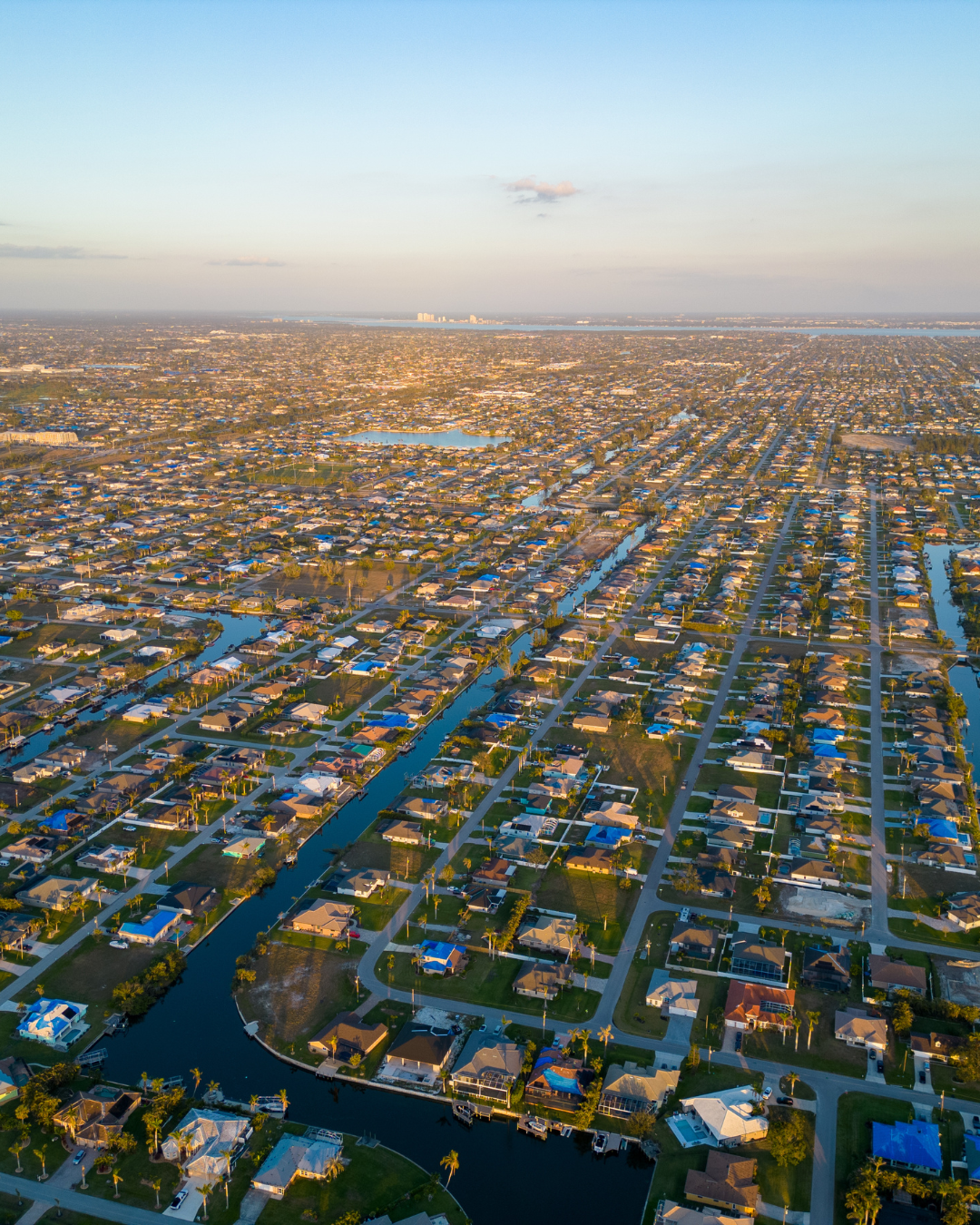
Aerial views of Cape Coral reveal the extraordinary density and reach of its residential canal communities.
Population Milestones
- 1970: Approximately 11,000 residents at the time of incorporation
- 1980: Population surpasses 32,000
- 1990: Over 74,000 residents — nearly doubling in a decade
- 2000: 102,000 residents — crossing the six-figure threshold
- 2010: 154,000 residents, despite the aftermath of the 2008 housing crisis
- 2020: Approximately 194,000 residents
- 2025: Estimated population of 225,000 to 230,000+, making Cape Coral one of the fastest-growing cities in the United States
To put this in perspective, Cape Coral is now the largest city by land area in Florida and one of the 75 largest cities in the United States. It is larger in area than the city of Miami. Yet its story is far from finished.
The Buyer Wave: Who Has Been Coming, and Why
The demographic composition of Cape Coral's buyer pool has shifted considerably across the decades, mirroring broader national trends while also responding to local market forces.
The Retiree Foundation (1960s–1990s)
The original wave of buyers was heavily composed of retirees and pre-retirees from the Northeast and Midwest — particularly Ohio, Michigan, Pennsylvania, and New York — who were drawn by the warm climate, low cost of living, and the novelty of owning waterfront property at prices far below what they'd seen in New England or the Great Lakes. This demographic remained dominant for decades and continues to be a meaningful segment of the market today.
The Real Estate Boom and Bust (2000s)
The mid-2000s brought a different kind of buyer: the speculative investor. Cape Coral, like much of Florida, experienced a frenzied escalation in property values between 2002 and 2006. Median home prices that had sat comfortably in the $100,000 to $150,000 range shot upward to $300,000 and beyond. Investors were flipping vacant lots and newly constructed homes at rates that ultimately proved unsustainable.
When the housing market collapsed in 2007–2008, Cape Coral was hit particularly hard. Median home prices plummeted more than 70% from peak to trough in some segments, and the city saw among the highest foreclosure rates in the nation. Entire streets sat largely vacant. It was a painful and defining moment for the community.
Yet the fundamentals never disappeared. The canals were still there. The climate was still there. The land was still there. And patient buyers who purchased during the downturn found themselves sitting on some of the most impressive real estate gains of the following decade.
The COVID-Era Migration Surge (2020–2022)
Perhaps no era reshaped Cape Coral's buyer demographics more dramatically than the COVID-19 pandemic period. As remote work became normalized and urban density became a source of anxiety, Americans began reconsidering where they wanted to live. Cape Coral — with its outdoor lifestyle, warm weather, water access, and relatively affordable prices compared to coastal markets in California or New England — became a top destination.
Between 2020 and 2022, Cape Coral ranked among the top ten fastest-growing cities in America according to U.S. Census Bureau estimates. Home prices surged again, with median values more than doubling in many zip codes in under three years. Properties were receiving multiple offers within hours of listing, often well above asking price, from buyers who had never set foot in Southwest Florida.
Post-Surge Stabilization and the Sophisticated Buyer (2023–2025)
Following the interest rate increases of 2022 and 2023, the frenzied pace of the pandemic boom cooled. But Cape Coral did not retreat — it recalibrated. The buyer pool evolved into a more discerning, financially qualified group: luxury buyers seeking Gulf-access waterfront estates, investors pursuing long-term rental income, and remote-working professionals choosing a permanent lifestyle upgrade over a temporary escape.
As of early 2025, Cape Coral's median home price hovers in the $380,000 to $420,000 range depending on the data source, with Gulf-access waterfront properties regularly trading in the $700,000 to $2.5 million+ range. Inventory has grown modestly compared to the pandemic lows, offering buyers more selection while still supporting competitive values for well-positioned properties.
Why People Are Still Choosing Cape Coral in 2025
- No state income tax — Florida remains one of only a handful of states with zero personal income tax, a powerful draw for high earners and retirees alike.
- Waterfront lifestyle at accessible price points — Canal-front homes remain far more affordable here than comparable waterfront properties in California, the Hamptons, or even Miami.
- Year-round sunshine — With an average of 265 sunny days per year, Southwest Florida delivers on the climate promise consistently.
- Boating, fishing, and outdoor recreation — The Gulf of Mexico is not just scenery; it is a daily lifestyle amenity for thousands of residents.
- Relatively low property taxes — Florida's Homestead Exemption and Save Our Homes cap on assessment increases make ownership particularly attractive for primary residents.
- Remote work flexibility — The normalization of hybrid and fully remote work has permanently altered where knowledge workers choose to live.
- Growing job market — Cape Coral and the broader Lee County region are expanding significantly in healthcare, technology, construction, and hospitality sectors.
Infrastructure: The City Is Finally Catching Up
For much of its history, Cape Coral's infrastructure lagged significantly behind its population growth. A city designed to sell waterfront lots was, for decades, underbuilt in terms of road capacity, utilities, and civic amenities. That reality is changing rapidly — and these improvements are poised to unlock a new phase of value appreciation across the market.

The Seven Islands Project
One of the most transformative development projects in Cape Coral's history is the Seven Islands mixed-use development at the northern tip of the city on the Caloosahatchee River. This ambitious project envisions a vibrant waterfront destination featuring a marina, hotels, restaurants, retail, residential towers, and public green space spread across seven man-made islands. Pending final approvals and phased development timelines, Seven Islands is expected to become Cape Coral's signature destination — comparable in impact to what Brickell City Centre did for Miami or what Waterside Shops did for Naples. This development alone has the potential to meaningfully reshape property values in the surrounding NW Cape Coral region.
Downtown Cape Coral Redevelopment
The city's original downtown core along Cape Coral Parkway and SE 47th Terrace has undergone sustained revitalization efforts over the past several years. New restaurants, breweries, boutique retailers, and entertainment venues have taken root, creating a walkable urban energy that was largely absent for most of the city's history. The Cape Coral Community Redevelopment Agency (CRA) continues to invest in streetscaping, lighting, and infrastructure improvements designed to accelerate this momentum.
Road and Traffic Improvements
Connectivity has long been one of Cape Coral's Achilles' heels. With only two bridges connecting the city to Fort Myers, peak-hour traffic has historically been a significant quality-of-life concern. The Florida Department of Transportation (FDOT) has ongoing and planned projects focused on widening key arterials, improving interchange capacity on Pine Island Road and Del Prado Boulevard, and exploring long-term solutions to the cross-river bottleneck. A proposed third bridge connecting Cape Coral to Fort Myers has been discussed in planning circles for years, and its eventual development — when it materializes — would be a seismic improvement to the city's accessibility and economic circulation.
Utilities Expansion
A significant portion of Cape Coral — particularly in the northwest and northeast quadrants — still relies on private septic systems and well water rather than city utilities. The phased expansion of city water and sewer service into these areas has been an active municipal priority. Properties that receive city utility connections typically experience meaningful increases in market value, improved environmental compliance, and greater appeal to a broader buyer pool. As these expansions continue, expect to see property values in the affected neighborhoods respond accordingly.
Healthcare and Education Investment
Cape Coral Hospital continues to expand its service capacity as the regional population grows. Additionally, Lee Health has invested in outpatient facilities and specialty care centers in the Cape Coral area, reducing the need for residents to travel to Fort Myers for medical services. On the education front, new school capacity projects and charter school expansions are working to keep pace with the growth in school-age population, a key concern for relocating families evaluating the area.
Looking Ahead: What the Future Holds for Cape Coral
Real estate forecasting carries inherent uncertainty, but the structural fundamentals supporting Cape Coral's long-term trajectory are among the most compelling of any market in the Sun Belt.
Population Growth Continues
Most demographic projections suggest Cape Coral will reach a population of 270,000 to 300,000 residents by 2035, with continued growth beyond that point. As long as Florida remains a net in-migration destination — and all current trends suggest it will — Cape Coral will absorb a significant share of that movement given its scale, affordability relative to South Florida, and lifestyle offerings.
Commercial and Economic Diversification
Cape Coral has historically been an overwhelmingly residential city with limited commercial development compared to its land mass. That is beginning to change. New commercial corridors are emerging, particularly along Pine Island Road and in the northeast quadrant of the city. The attraction of employers in technology, healthcare, and professional services — combined with a workforce that no longer needs to commute daily — is supporting a more balanced economic base than the city has traditionally maintained.
Resilience Investment After Hurricane Ian
Hurricane Ian made landfall just south of Cape Coral in September 2022 as a powerful Category 4 storm, causing widespread damage and testing the community's resilience in profound ways. The recovery, while challenging, has been remarkable. Billions of dollars in rebuilding have occurred across the city, and many properties have been elevated, retrofitted, and rebuilt to current hurricane-resistant standards. This rebuilding process has, in many cases, resulted in a younger, more resilient housing stock than existed before the storm. Continued investment in drainage, seawall reinforcement, and emergency preparedness infrastructure is making the city more storm-resistant for the long term.
Luxury Market Deepening
The upper tier of Cape Coral's real estate market is maturing rapidly. As the city's reputation and amenity base continue to grow, it is attracting buyers who previously might have looked exclusively at Naples or Sarasota for luxury waterfront properties. The deepening of the luxury segment — with custom-built Gulf-access estates, high-end new construction, and boutique waterfront communities — is elevating the overall profile of the market and drawing national and international buyer attention.
"Cape Coral is no longer just the affordable alternative to Naples. It has developed its own luxury identity, its own waterfront culture, and its own compelling story that stands entirely on its own merits."
— Jeff Miloff, The Keyes Miloff Aubuchon Group
The Bottom Line
Cape Coral's journey from a raw marshland sales project to one of Florida's most dynamic real estate markets is a story about vision, resilience, and the enduring appeal of waterfront living. The city has survived speculative booms, a devastating housing crash, a catastrophic hurricane, and a global pandemic — and it has emerged from each chapter larger, stronger, and more desirable than before.
The infrastructure investments currently underway are not cosmetic upgrades. They represent a city making a serious, sustained commitment to accommodating its future. When those commitments fully materialize — the third bridge, the Seven Islands development, the utility expansions, the downtown renaissance — the Cape Coral of 2030 will look substantially different from the Cape Coral of today. And for buyers who understand what is coming, the opportunity to position ahead of that transformation is very much still available.
Whether you are drawn by the canals, the climate, the community, or the compelling investment fundamentals, one thing is clear: Cape Coral's story is still being written — and the most exciting chapters may lie just ahead.